Feature
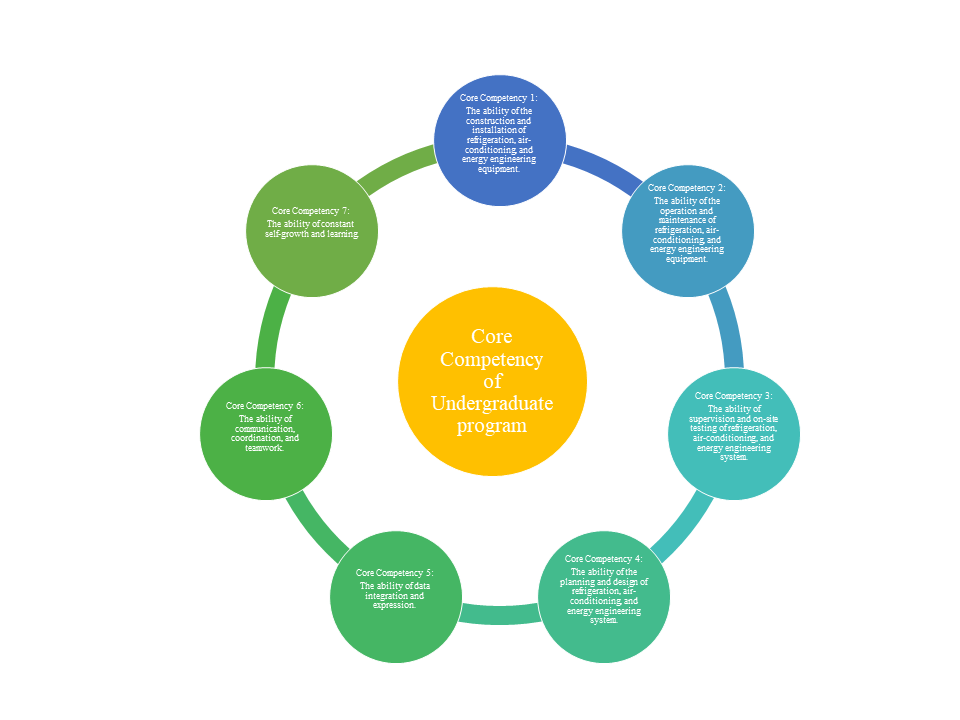
1.The technology R&D focused by the Department includes the R&D and testing of refrigeration, air-conditioning and energy-saving equipment (including industrial or bioenvironmental control technology, frequency converting and energy efficiency technology) and integration of renewable energy and air-conditioning system technology (including solar thermal energy, hydrogen energy and fuel cells, heat pump dehumidification system, and energy efficiency for residence and office buildings)
2.Key development features of teaching
2.1 Undergraduates:
-
The Department’s curriculum is divided into three areas: “Refrigeration and air-conditioning technology”, “mechatronics technology”, and “energy application technology”. The courses designed fit the needs of these industries, future trends, knowledge development and technological progress.
-
Department-based courses are designed to have students be qualified to be refrigeration and air-conditioning engineers, refrigeration and air-conditioning technicians, electromechanical equipment engineers and energy management engineers.
-
Teachers are encouraged to make their own digital and audio-visual teaching materials.
-
The Department, which pays attention to development of students’ practical techniques, has established the “Refrigeration and Air-conditioning Installation and Repair Level B” test site equipped with relevant equipment for Electrical Equipment Inspection training site.
-
The Department works with the Industrial R&D Center of Ho Tai Development Co., Ltd. to provide
(1)Variable Frequency Air-Conditioning Practice
(2)Variable Frequency Air-Conditioning Practice
(3)Variable Frequency Air-Conditioning Practice
(4)Variable Frequency Air-Conditioning Practices
-
The Department provides students with learning and employment assistance and understands employment of its graduates through the Alumni Association.
-
The Department, which emphasizes students' practical experience accumulated, arranges for off-campus internships in winter and summer vacations and encourages students to participate in the internships provided by its partner establishments.
-
The Department provides counseling for students to acquire professional licenses and certificates, and include acquisition of licenses or certificates into the graduation requirements.
-
The Department invites experts from the industry to co-teach at the Department.
2.2 Master’s program
-
As for the curriculum for general students in the master’s program, “Seminar” is a required course provided for students in their 1st and 2nd years, and “Refrigeration and Air Conditioning System Engineering”, “Advanced Thermodynamics”, “Advanced Heat Transfer”, and “Advanced Fluid Mechanics” are core elective courses. Students are required to take at least 2 of these 4 elective courses to develop their professional knowledge.
-
For enhancement of students' practical ability in the workplace, external scholars and experts are invited to give speeches for students in the master’s program and the in-service master’s program.
-
To expand international perspectives of graduate students, the Department provides the scholarship for students to participate in international conferences.
-
Students participate in the industry-academy research projects to improve their research level and facilitate close connection between professional technical talents and the industry.
-
Each student in the master’s program shall publish at least one thesis at a seminar or in a journal.
3.Emphases of industrial services and R&D development characteristics
-
Conduct the R&D projects funded by government agencies (Ministry of Science and Technology, Ministry of Economic Affairs, Ministry of Education, etc.) and cooperate with the industry actively to provide technical counseling for the issues encountered by the regional industry and carry out industry-academy cooperation activities, including the development of energy efficient components, the evaluation of energy-saving systems and energy-saving effects, the analysis of efficiency improvement, the efficiency of cleanroom or negative pressure isolation ward, the analysis of flow field, the analysis of heat dissipation effect of high-power electronic component thermal module, the development of solar thermal energy air-conditioning system, the research on planting environmental control and indoor air quality, thermal energy recovery and application, chemical dehumidification technology, organic Rankine cycle, and direct methanol or hydrogen fuel cell efficiency and application.
-
Regularly conduct technical seminars with the central office of Refrigeration and Air-Conditioning Technicians Association and provide a platform for technical exchanges between the industry and the academic community in the central region, enabling the industry's latest technology and R&D results to be exchanged instantly and enhancing the connection between the industry and the Department.
※According to a report issued on Cheers magazine in 2015 concerning Taiwan’s top 15 universities of technology, NCUT was ranked the 32nd among all universities, and the 11th among universities of technology. In 2015, according to the survey conducted by the 1111 Job Bank for “enterprises’ favorite universities in 2015”, NCUT was ranked the 7th. NCUT was ranked the 5th in the survey for business talent strategy and the survey for enterprises’ favorite college students conducted in 2015. The results of the 3 surveys show that NCUT has achieved outstanding academic performance and it has been the top university in the central region. Performance of students graduated from NCUT has been recognized.


 Home
Home Contact Us
 Sitemap
 NCUT
NCUT EN
EN